The purpose of the diploma project is development of non-contact temperature measuring device with additional functions and mobile application that can be used both for production purposes and in everyday life.

Within this project the theoretical bases of non-contact temperature measurement were investigated, the remote measurement device of temperature indicators of radiation type was designed, optical system of the device was modeled and calculated, components were selected, functional and basic electric schemes, assembly drawings and mobile application for convenient device control were developed.

The purpose of this diploma project is to develop an ultrasonic device to control the heat consumed in residential buildings and enterprises, as well as to control the coolant.

In the diploma modern variants of devices with the analysis of the principle of action and their use in various spheres of activity were considered, the comparative characteristic with schemes and tables is given. Conclusions are made regarding the priority of using an ultrasonic heat meter and suggestions for its improvement.
The operation of this device is based on the method of ultrasonic measurement. The device consists of an electric computer, a flow meter with ultrasonic sensors and temperature sensors.

In this thesis two-parameter stethoscope was developed for controlling rods of non-ferromagnetic materials with a diameter of 34-35 mm. For example, samples from bronze and duralumin were used.

In the first section were presented theoretical information of eddy current control, two-parameter control, as a kind of multi-parameter control. The theoretical data on types and species of eddy current converters are described. Also, such methods of signal processing as amplitude, phase and amplitude-phase are described.
In the calculation part of the work presented calculations of the eddy current converter itself, as well as its work in two modes: the first - at high frequency to control the diameter of the OK, the second - at low frequency, to control the electrical conductivity OK. The chosen method is substantiated, and graphs are given that prove that the chosen method is the most correct one. The third part - design and technological describes the technical characteristics, and the principle of this device. The block diagram of the device is given, and the functional scheme is developed. This appliance meets all the delivered tasks.

In the diploma project, a research was carried out on microcurrent NK and the search for defects in riveting compounds. In the first section was given an analysis of the object of control and the formulation of the problem of study in which were considered: types of riveted joints, types of rivets, the use of rivets. The second section deals with general information about the vortex current type of non-destructive control. The third section reviews the structures of the WWW and the work of the VSD, the calculation of the overhead transformer GSP, the description and calculation of the main elements of the VSD

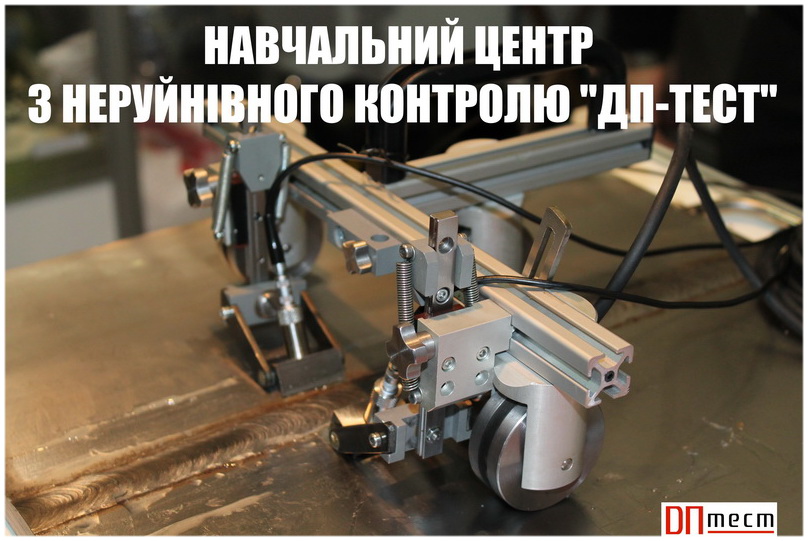
The purpose of the project is to design a device based on the TOFD method, which would be suitable for a set of tasks (control welded joints to connect)
with a wall thickness of 15 to 50 mm.

In this work, a device for controlling welded joints of cisterns of large diameter or metal sheets based on the TOFD method was developed. Nowadays, more and more UDC control is taking place in such fields as aircraft construction, railways, chemical industry, NPP reactors, etc. Therefore, the requirements for quality and speed of inspection are coming to the fore. The diffraction-time method is united in itself the speed of control and the high probability of detecting a defect. For this method, a functional diagram of the device was developed, the scanner itself was designed on which it was placed, and by which the converters are moved along the OK.

АСНК КПІ ім. Ігоря Сікорського, 2021